In a word, Yes! The sun (together with the rest of the solar system) orbits the barycentre of the Milky Way. The sun's orbit is not exactly in the plane of the MW so it appears to bob up and down relative to the galactic equator..
Keeping this in consideration, why does the sun move up and down?
Earth rotates or spins toward the east, and that's why the Sun, Moon, planets, and stars all rise in the east and make their way westward across the sky.
Additionally, how does the sun move? Answer: Yes, the Sun - in fact, our whole solar system - orbits around the center of the Milky Way Galaxy. We are moving at an average velocity of 828,000 km/hr. But even at that high rate, it still takes us about 230 million years to make one complete orbit around the Milky Way!
Also know, does the sun go up and down?
As the earth rotates different locations on earth pass through the sun's light. The sun isn't actually moving up or down, but it appears to rise and set because of the earth's rotation on its axis.
Does the sun move around the earth?
It takes the Sun 25 days to spin, or rotate, completely around. The Earth, which is the third planet from the Sun, takes 24 hours to rotate. The Earth's path around the Sun is called its orbit. It takes the Earth one year, or 365 1/4 days, to completely orbit the Sun.
Related Question Answers
Where does the sun rise first?
North of Gisborne, New Zealand, around the coast to Opotiki and inland to Te Urewera National Park, The East Cape has the honour of witnessing the world's first sunrise each and every day. Back in 2011, Samoa took the decision to move position on the international dateline.Why is the sky blue?
Blue light is scattered in all directions by the tiny molecules of air in Earth's atmosphere. Blue is scattered more than other colors because it travels as shorter, smaller waves. This is why we see a blue sky most of the time. Closer to the horizon, the sky fades to a lighter blue or white.What direction does the sun move?
The Sun rises in the east (near arrow), culminates in the north (to the right) while moving to the left, and sets in the west (far arrow). Both rise and set positions are displaced towards the south in midsummer and the north in midwinter.Can Sun rise from west?
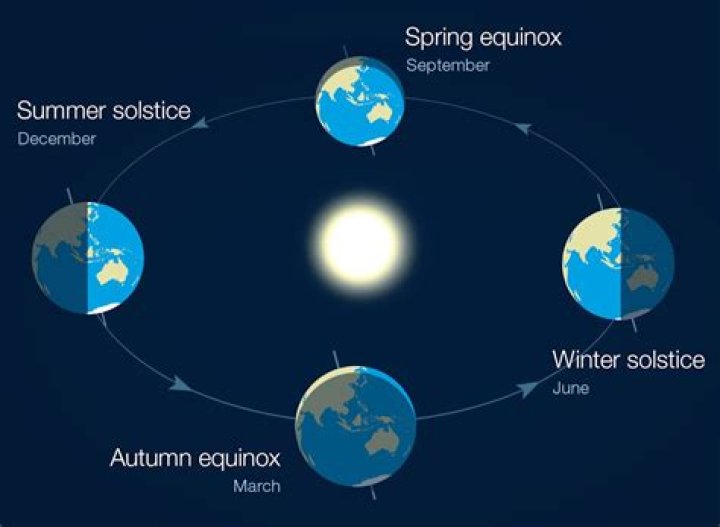
Actually, the Sun only rises due east and sets due west on 2 days of the year -- the spring and fall equinoxes! On other days, the Sun rises either north or south of "due east" and sets north or south of "due west." Each day the rising and setting points change slightly.How fast does the sun move?
The sun and the solar system appear to be moving at 200 kilometers per second, or at an average speed of 448,000 mph (720,000 km/h).What times does the sun set?
Spring 2020: Sunrise and Sunset Times
| Date | Sunrise | Sunset |
| April 01, 2020 | 6:14 am | 6:50 pm |
| April 15, 2020 | 5:54 am | 7:02 pm |
| . |
| May 01, 2020 | 5:35 am | 7:16 pm |
On which date is the sun's path the longest?
June 21
How long is the lunar cycle?
It takes 27 days, 7 hours, and 43 minutes for our Moon to complete one full orbit around Earth. This is called the sidereal month, and is measured by our Moon's position relative to distant “fixed” stars. However, it takes our Moon about 29.5 days to complete one cycle of phases (from new Moon to new Moon).What does civil twilight mean?
Civil twilight is a scientific term, and we define it as “the period after sunset or before sunrise ending or beginning when the sun is about 6 degrees below the horizon and during which on clear days there is enough light for ordinary outdoor occupations.” Some sources claim that the word was coined by the SwissDoes the sun rise exactly in the east?
The Sun rises due exactly east and sets due exactly west on only two days of every year. Sunrises and sunsets happen because Earth spins, counter-clockwise if we look down at the North Pole. Earth's tilt means there are only two days per year that the Sun rises exactly due east.What happens at sunset?
Sunset, also known as sundown, is the daily disappearance of the Sun below the horizon due to Earth's rotation. As viewed from the Equator, the equinox Sun sets exactly due west in both Spring and Autumn. Night occurs when the Sun reaches 18 degrees below the horizon and no longer illuminates the sky.Does the sun have day and night?
Yes! All the planets in our solar system spin on their axes (so does our Sun!) and so they have day and night cycles. There are differences, however, in the length of day and night — the cycles are made even more complex by the tilt of a planet's axis and its rate of orbit.What is dawn time?
Dawn, from an Old English verb dagian: "to become day", is the time that marks the beginning of twilight before sunrise. It is recognized by the appearance of indirect sunlight being scattered in the atmosphere, when the centre of the Sun's disc reaches 18° below the horizon.Why does the sun rise and set Mystery Science?
Position a globe so that light from the sun shines on it in just the same way that sunlight shines on the Earth. As the Earth spins, the boundaries between 'day' and 'night' will move steadily across both your globe and the Earth. A more detailed version of this activity can be found at Earth Learning Ideas.Does the sun rotate?
On average, the sun rotates on its axis once every 27 days. However, its equator spins the fastest and takes about 24 days to rotate, while the poles take more than 30 days. The inner parts of the sun also spin faster than the outer layers, according to NASA.Why does Sun look bigger at sunset?
Light from the lower edge of the Sun's disk is refracted more than light from the upper edge. This reduces the apparent height of the Sun when it appears just above the horizon. The width is not affected, so the Sun appears wider than it is high.How long does it take for the moon to revolve once around Earth?
about 27.32 days
Why don't we feel the earth moving?
If we're being precise, Earth is slowing down ever so slightly thanks to the Moon being a bit of a gravitational drag. It pulls on the tidal bulge of our planet, which causes tidal friction, putting energy into the Moon's orbit.Do stars move?
The stars move along with fantastic speeds, but they are so far away that it takes a long time for their motion to be visible to us. You can understand this by moving your finger in front of your eyes. Even when you move it very slowly, it may appear to move faster than a speeding jet that is many miles away.